
15 Famous Traditional Indian Prints and Patterns: Types, Fabrics & Their History
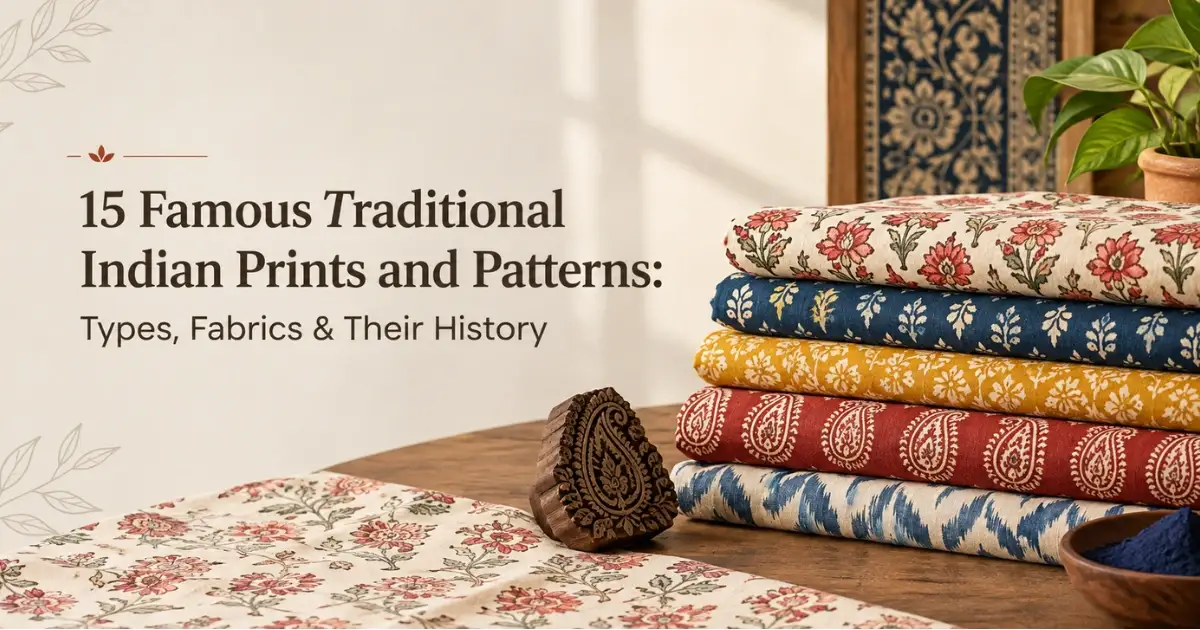
Have you ever looked at a printed Indian fabric and wondered what the pattern was called?
Maybe it was a deep blue fabric covered in tiny geometric shapes or a colourful bandhani dupatta or a fabric with those beautiful paisley-like elements.
Indian textiles have a way of making even a simple outfit interesting. And there is a reason. Indian prints are not just pretty designs placed on a fabric. Many of them have a history, a place of origin, and a traditional technique behind them.
Some are made using wooden blocks, and some use resist dyeing, while others are created by tying and dyeing the fabric or painting directly on it. What makes them even more special is that many of these techniques are still practised today.
What makes Indian prints so special?
Indian textiles have always had a strong connection with art in everyday life.
Different regions developed their own methods of decorating textiles, shaped by local materials, cultural traditions, and techniques passed down through generations. This is the reason you will find such a variety of Indian prints and patterns.
Some feature delicate floral motifs, others use bold geometric patterns, while art-inspired traditions can depict mythology, nature, daily life, and religious stories.
15 Famous Indian Textile Prints, Patterns & Traditional Art Forms
Ajrak print
An ajrak is an old style of block printing with indigo dye that hails from the province of Sindh in Pakistan and also the region of Kutch in Gujarat, India, famous for its beautiful blue, red, and black colour scheme as well as geometric and floral designs.
Bagru print
Bagru is a technique of hand block-printing that originated in the state of Rajasthan. The particular use of an earthy colour palette along with botanical motifs and geometric designs makes the Bagru fabric unique in its own way.
Dabu print
The characteristic feature of Dabu prints is their earth tones and their rustic look. It is a traditional mud-resist technique from Rajasthan. A mud-based paste is applied to parts of the fabric before dyeing.
After dyeing, the fabric is washed to remove the resist, revealing the areas that were protected from the dye. The technique produces distinctive patterns with an earthy palette and subtle variations that reflect its handmade process.
Bandhani print
You can probably recognise bandhani even if you don't know its name. Those tiny dots and colourful patterns are its signature. Bandhani is a tie-dye technique strongly associated with Gujarat and Rajasthan.
Small sections of the fabric are tightly tied before dyeing, creating areas that resist the colour and form Bandhani’s characteristic dotted patterns. Bright yellow, green, pink and purple shades are common.
Kalamkari print
Kalamkari is for you if you love a print that feels more like artwork. The name Kalamkari comes from the words kalam, meaning pen, and kari, meaning work or craftsmanship.
Traditional Kalamkari involves hand-drawing, painting, and block printing, with motifs inspired by nature, mythology, religious traditions, and Indian storytelling. Common motifs include flowers, birds, foliage, mythological figures, and detailed narrative scenes.
Sanganeri print
Another Rajasthani favourite is Sanganeri print which is also known for delicate floral designs. Sanganeri printing is particularly known for its fine detailing, delicate floral motifs, and relatively light, refined aesthetic. Common floral motifs include roses, lotuses, marigolds, and other delicate botanical forms.
Bagh Print
Named after the town of Bagh in Madhya Pradesh, Bagh printing is known for its striking red-and-black colour palette and intricate patterns. The traditional technique involves hand-carved wooden blocks and natural dyes. Geometric and floral motifs are common, giving Bagh textiles their distinctive earthy character.
Ikat
Ikat is slightly different from traditional surface printing. Instead of printing the fabric the yarn itself is tie-dyed before weaving. Because sections of the yarn are tied and dyed before weaving, the finished pattern often has characteristic soft or slightly blurred edges.
Pochampally ikat
Pochampally Ikat is a renowned form of ikat associated with Telangana, particularly the Pochampally region. It is known for strong geometric designs and repeated patterns. Because the yarn is resist-dyed before weaving, the pattern emerges as the dyed threads are carefully aligned and woven together.
Patola
If you have ever seen a colourful Gujarati textile covered in detailed geometric elements there is a good chance it was inspired by patola.
Traditional patola is especially known for the double ikat technique where both the warp and weft yarns are resist-dyed before weaving. The process is extremely detailed and requires considerable skill, precision, and time. Traditional designs might feature geometric arrangements and elements like birds and animals.
Lehariya
The name lehariya comes from the wave-like appearance of its stripes. The traditional tie-and-dye technique is particularly associated with Rajasthan. The fabric is folded or tied in a particular way before dyeing, creating flowing diagonal or wave-like stripes.
Batik
Batik creates patterns through wax-resist dyeing rather than conventional surface printing. Wax is applied in certain parts of the fabric before dyeing and the wax prevents the dye from reaching those areas. Once the wax is removed the design appears. It can create everything from simple patterns to detailed artistic designs.
Buti pattern
Sometimes a pattern does not need to cover the entire fabric to make an impact. Buti refers to small decorative elements that are repeated across fabric using techniques such as block printing, weaving, embroidery, or other forms of textile decoration. These elements are often floral, botanical, geometric, or inspired by nature.
Pichwai patterns
Pichwai is more closely related to the Indian painting tradition than a conventional textile printing technique. The paintings traditionally depict stories and imagery associated with Lord Krishna, particularly the devotional traditions of Nathdwara in Rajasthan. These detailed artworks have also inspired patterns used on fabrics and decor. The designs can be rich and detailed and full of colour.
Warli patterns
Warli is a traditional art form associated with the Warli communities of Maharashtra. The artwork is famous for simple geometric and animal figures arranged to depict scenes from everyday life, celebrations, farming and community activities.
Conclusion
Indian textiles have never been simply about clothing. They carry stories of regions, communities, traditions and creativity. While some techniques have evolved with time while others continue to be practised by artisans using knowledge passed down through generations.
Interested in discovering more about India’s textile traditions and craftsmanship?
Explore Studio Tokri to find thoughtfully custom-made clothing from independent Indian designers and creators, bringing traditional Indian craftsmanship into styles you can enjoy today.