
Top 15 Indian Fashion Designers Who Changed Indian Fashion
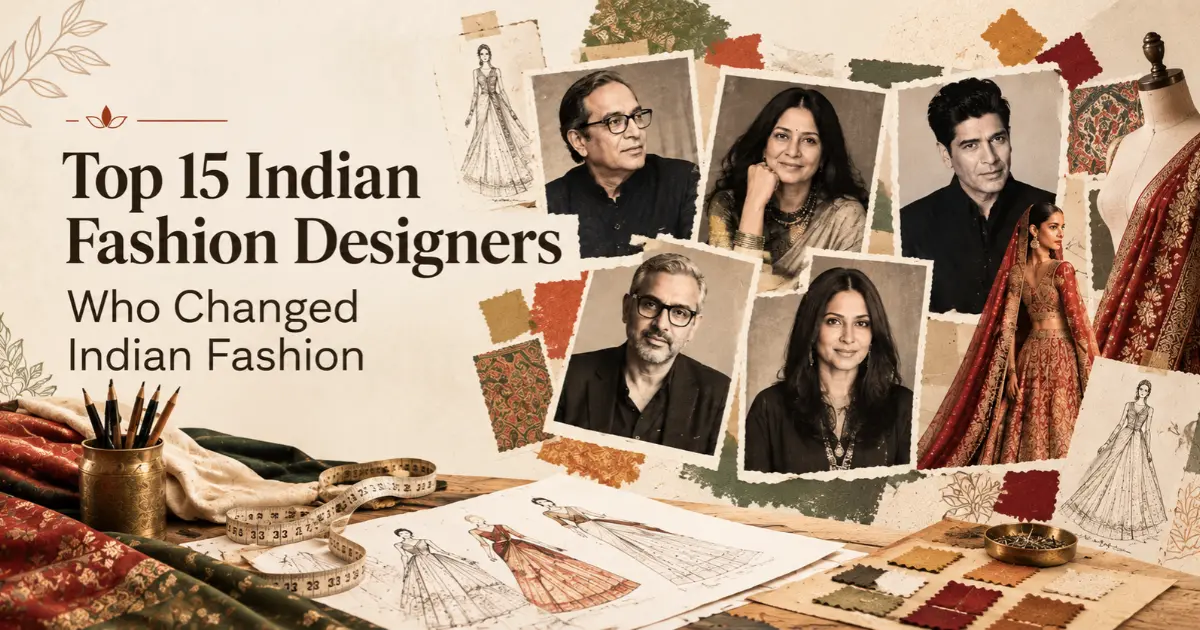
Indian fashion has never been just about beautiful clothes. It is closely tied to textiles, embroidery, cinema, weddings and the way India itself has changed over the years. The designers who shape this industry understood that. Some brought Indian couture into Bollywood. Others took traditional crafts to international runways. A few completely changed the way you look at the saree, bridal wear or even what Indian couture can be.
Manish Malhotra
In the 1990s, Manish Malhotra played a key role in transforming Bollywood fashion. Before he became synonymous with celebrity weddings and fashion, he was working in costume design.
His breakthrough came with Rangeela in 1995, where the clothes worn by Urmila Matondkar became an important part of the visual identity of the film, thus winning the first ‘Best Costume Design’ award that year.
That was a major shift. Costumes were no longer just something actors wore for a scene; they could influence what young Indians wanted to wear outside the cinema hall.
His award list is also impressive. He received the first IIFA award for costume design in 2001, followed by awards in 2002, 2004 and 2008, along with other major fashion honours such as Zee Cine Awards, Iconic Gold Awards and more.
Sabyasachi Mukherjee
Born on 23rd February 1974, Sabyasachi Mukherjee began his career at Lakmé Fashion Week in 2002. His designs combine Indian textiles, regional crafts, handwoven fabrics and intricate embroidery with a vintage, royal look. His international fashion empire extends beyond bridal couture to jewellery, accessories and menswear. His designs have been worn by celebrity brides including Deepika Padukone, Anushka Sharma and Priyanka Chopra.
Tarun Tahiliani
Tarun Tahiliani belongs to the generation that helped establish India's modern designer industry. He studied fashion design at the Fashion Institute of Technology (FIT) in New York. Tarun Tahiliani is also a founding member of the Fashion Design Council of India (FDCI). Along with his wife, Sailaja “Sal” Tahiliani, he co-founded Ensemble, which opened in Mumbai in 1987 as a multi-designer boutique.
He's especially known for making traditional Indian clothing easier to wear in contemporary settings. His designs combine Indian and European influences with a distinctive mastery of draping. He brought Indian couture to the Indian as well as the international luxury markets, making it relevant with traditional techniques, architectural silhouettes and innovative textile construction.
Anita Dongre
Anita Dongre 's contribution is slightly different from that of many designers. Instead of just limiting her work to heavy pieces, she has built a larger fashion house that includes contemporary clothing, bridal wear and crafted, focused collections.
Anita Dongre’s creations are more than just contemporary clothing and bridal fashion. She is the founder of House of Anita Dongre, which includes brands such as AND, Global Desi, and Anita Dongre Grassroot. She also broke new ground for Indian fashion by opening her standalone flagship store in SoHo, New York.
Her collections use traditional methods such as gota patti, hand-painted details and fine embroidery, supporting rural artisans and showing that responsible fashion can scale commercially without losing its Indian identity.
Masaba Gupta
Masaba Gupta was born in 1989 and she showcased her first collection in Lakmé Fashion Week at the age of 19. At House of Masaba, she created a distinctive identity with playful prints, vibrant colours and easy silhouettes. With Kattran, her debut collection, Masaba began carving out her place in the fashion world, earning the INIFD Most Promising Designer Award.
Her playful designs appeal to younger audiences and influencers. She proved that Indian fashion could create a strong identity with prints and visual branding, rather than primarily relying on embroidery.
Abu Jani and Sandeep Khosla
Abu Jani and Sandeep Khosla are known for their maximalist couture with gota patti, chikankari, zardozi, mirror work and intricate hand embroidery. Their decadent fabrics and dramatic silhouettes achieve opulence and elegance. For films like Devdas, they brought their craftsmanship to cinema audiences through their costume work. Together, they helped establish Indian couture as a distinct style of luxury, elaborate and heavily embellished.
Anamika Khanna
Anamika Khanna is among the designers who challenged conventions and brought a fresh perspective to Indian fashion. Her achievements earned recognition in 1995 when she received the Damania Fashion Award, a notable accolade in the Indian fashion industry. The year 2007 marked a defining moment in Anamika Khanna’s career, as an invitation to Paris Fashion Week opened new doors to international recognition.
Her work often starts with something familiar like a saree and then changes the construction completely. Anamika Khanna blends innovative draping, deconstructed saris, unconventional construction and Indo-Western silhouettes. Her designs combine structured jackets, capes and trousers with traditional embroidery.
Ritu Kumar
Talking about the history of Indian fashion designers without mentioning Ritu Kumar would leave out an important part of the story. Ritu Kumar began working at a time when the organised Indian designer industry was still developing. Her work helped bring traditional Indian textiles and embroidery into contemporary fashion.
Rather than just treating Indian crafts as old-fashioned, she showed that they could work beautifully in modern garments. With native crafts, historic references and fine embroidery, she brought traditional Indian textiles to the modern fashion world.
Her work connects traditional techniques and modern clothing, giving handicrafts a place in everyday and occasion wear. Apart from design, she has played an important role in preserving India’s textile heritage. In 2013, she was awarded the Padma Shri for her contribution to Indian fashion over the last 40 years.
Rohit Bal
Rohit Bal created a unique royal aesthetic through luxurious fabrics, floral motifs, Kashmiri needlework and rich patterns. His dramatic colour palettes and theatrical presentations gave his collections a signature character. Time magazine called him “India's maestro of fabric and imagination.” His legacy is still closely associated with expressive, regal couture rooted in Indian heritage.
Gaurav Gupta
Gaurav Gupta represents a very different kind of contemporary Indian fashion. Instead of asking how to make traditional clothing more ornate, he asks what a garment can become. His sculptural gowns and fluid draping often look closer to wearable sculpture than typical Indian wear. His work frequently references the saree, but it turns it into something much more architectural. Gaurav Gupta is taking Indian couture to the avant-garde, experimenting with fabrics, sculptural shapes and fluid draping to create wearable art. His clothes are visual storytellers through unconventional structures.
In January 2025, his Spring Summer haute couture collection, Across the Flame, was presented at Paris Haute Couture Week. Inspired by a traumatic fire incident involving Gupta and his life partner, Navkirat Sodhi, the collection explored themes of resilience, healing, transformation and rebirth.
Rahul Mishra
Rahul Mishra stories are especially interesting because they are connected to Indian craftsmanship. He studied at the National Institute of Design and later in Milan. His collections often feature amazing embroidered pieces inspired by flowers, forests, architecture, and Indian culture.
But the bigger contribution is the way he places experts at the centre of the design process. In 2014, Rahul Mishra became the first Indian designer to win the International Woolmark Prize.
Sustainability and slow fashion continue to be at the core of his approach, with craftspeople having a prominent role in production. His work shows how Indian craftsmanship can flourish in the sphere of international luxury fashion.
Neeta Lula
Neeta Lulla's contribution to Indian fashion cannot be separated from Indian cinema. She has worked on hundreds of films and has created costumes for some of the industry's biggest productions. Her work is especially associated with elaborate costumes and character-driven styling.
Neeta Lulla has worked on over 300 Bollywood films, including Jodhaa Akbar, where she designed Aishwarya Rai's Iconic Red Lehenga.
She is a period-film connoisseur, blending historical research with meticulous visual storytelling. Her work shows how clothing can set a film’s era, character and identity and emphasises the close relationship between costume design and Indian cinema.
Falguni and Shane Peacock
The husband-and-wife designer duo Falguni Peacock and Shane Peacock founded Indian luxury fashion house "Falguni Shane Peacock" in 2024. They developed a signature style that was built around dramatic silhouettes, metallic accents, feathers and maximalist embellishment.
Their designs blend Indian craftsmanship with international red-carpet glamour. Their use of unconventional materials and bold construction makes for distinctive statement pieces, helping bring Indian embellishment into the global celebrity fashion scene.
Anju Modi
Anju Modi is a veteran Indian fashion and costume designer whose work draws on Indian textiles, traditional craftsmanship and historical clothing. Her design philosophy bridges heritage and modernity, shaped by extensive research into textile traditions and artisanal techniques.
Her costume designs for Sanjay Leela Bhansali’s period romance Bajirao Mastani (2015) brought her understanding of historical clothing and intricate period detailing to a wider audience. In 2016, she won the Filmfare Award for Best Costume Design for the film.
Through her work, Modi highlights the importance of preserving India’s textile heritage, traditional craftsmanship and the skills of its artisans while giving these traditions a contemporary expression.
Manish Arora
Manish Arora infused Indian fashion with an experimental approach, using bright colours, pop-culture references, graphic prints and elaborate embellishment. His quirky silhouettes and playful use of Indian craftsmanship helped to place his collections on international fashion platforms like Paris.
In recognition of his contribution to fashion, he was conferred France’s Chevalier de la Légion d’Honneur (Knight of the Legion of Honour), one of the country’s highest distinctions.
He combined traditional embroidery with futuristic and artistic influences, expanding the world’s perception of Indian fashion beyond traditional silhouettes and bridal couture.
Conclusion
The story of Indian fashion is not just about one designer being better than another. Each generation solved a different problem. Ritu Kumar helped establish the importance of Indian textiles while Manish Malhotra showed how powerful the relationship between cinema and fashion could be.
And the newer generation has pushed even further, questioning what an Indian silhouette can actually be. If there is one thing that the Indian design history of the last few decades tells you, it is that Indian fashion works best when designers respect where it came from but are not afraid to change where it is going.
Turn Your Creativity into Opportunity
Are you a fashion designer looking for a place to showcase your work? Meet Studio Tokri, a designer-first marketplace built especially for designers like you! Showcase your creations, build your digital portfolio, and sell your designs with zero commission. It’s a simple way to get your work noticed, connect with potential buyers, and grow your fashion business.
Ready to put your designs out there? Join Studio Tokri!
Read more:
Types of Fashion Designers and Their Role in the Fashion Industry
Types of Fabric: 15 Fabrics Every Fashion Designer Should Know